The natural environments we protect
The Nature alliée project aims to protect an area of more than 2 million hectares of carbon-rich forests and wetlands spread over 30 sites in 15 regions of Quebec. Approximately 72% of the area covered by our project’s sites are located in boreal forest, while 28% are in temperate forest.
How did we choose these sites? What makes them indispensable?

Nature: our climate ally
Natural environments (forests, peatlands, wetlands and aquatic environments) are huge pools that capture and store carbon. In Quebec, our natural environments contain more than 20 gigatonnes of carbon—the equivalent of 2,000 years of carbon emissions1 by all vehicles in the province2.
By protecting nature, we help prevent the premature release of large amounts of carbon into the atmosphere. For example, over 100 years, an intact forest will store at least 29 tonnes of carbon per hectare more than a forest exploited by the forestry industry3. While only covering 6% of Quebec’s territory, peatlands contain more than 50% of the province’s total carbon4.
By protecting these natural environments, we are also helping to protect several endangered species, such as the woodland caribou, silver-haired bat, wood turtle and peregrine falcon.
What is an old-growth forest?
An old-growth forest contains a significant concentration of trees over 100 years old, while also comprising young trees that ensure regeneration as the old trees die off. Older trees have the advantage of having accumulated large amounts of carbon over the decades, and the younger trees gradually replace dead wood while helping to maintain the forest’s capacity to remove carbon from the atmosphere. Another important element of old-growth forests is dead wood, which serves as an important habitat for many species and a source of food for many insects and decomposers.
- Every year, Quebec forests capture the equivalent of double the greenhouse gases (GHGs) released by all of the province’s vehicles, equating to more than 58 million tonnes of CO₂eq5.
- Undisturbed forests contain 30% to 50% more carbon than those exploited or degraded6.
- Quebec forests contain more than 22,000 species of vertebrates (mammals, birds, fish, amphibians and reptiles), plants and insects, many of which depend on old carbon-rich forests to survive7.

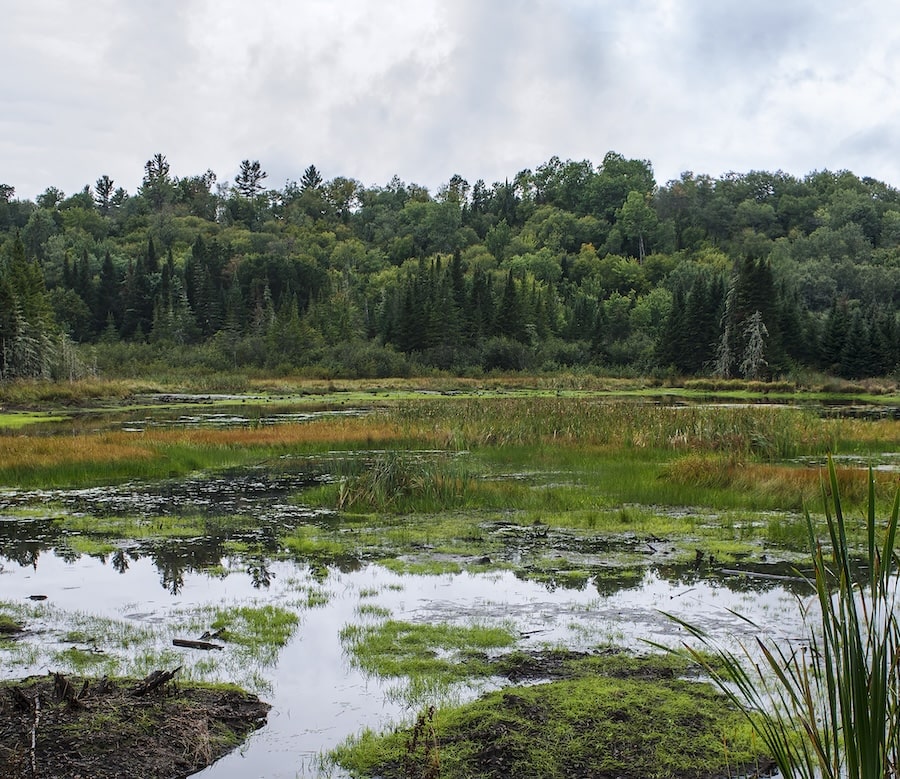
What is a wetland?
Wetlands represent 11% of Quebec’s territory and include marshes, swamps, peatlands and ponds8. Unlike freshwater bodies, such as lakes, the water is shallower and may not be present all year round. Waterlogged soil creates an oxygen-poor environment that slows down the decomposition of dead plant material and promotes carbon storage.
- Wetlands contain large quantities of carbon—up to nine times higher than in forest soils9.
- Thanks to their strong resistance to fires and insect outbreaks, peatlands can protect their carbon stocks for millennia10.
Fragile and threatened natural environments