
September 2044
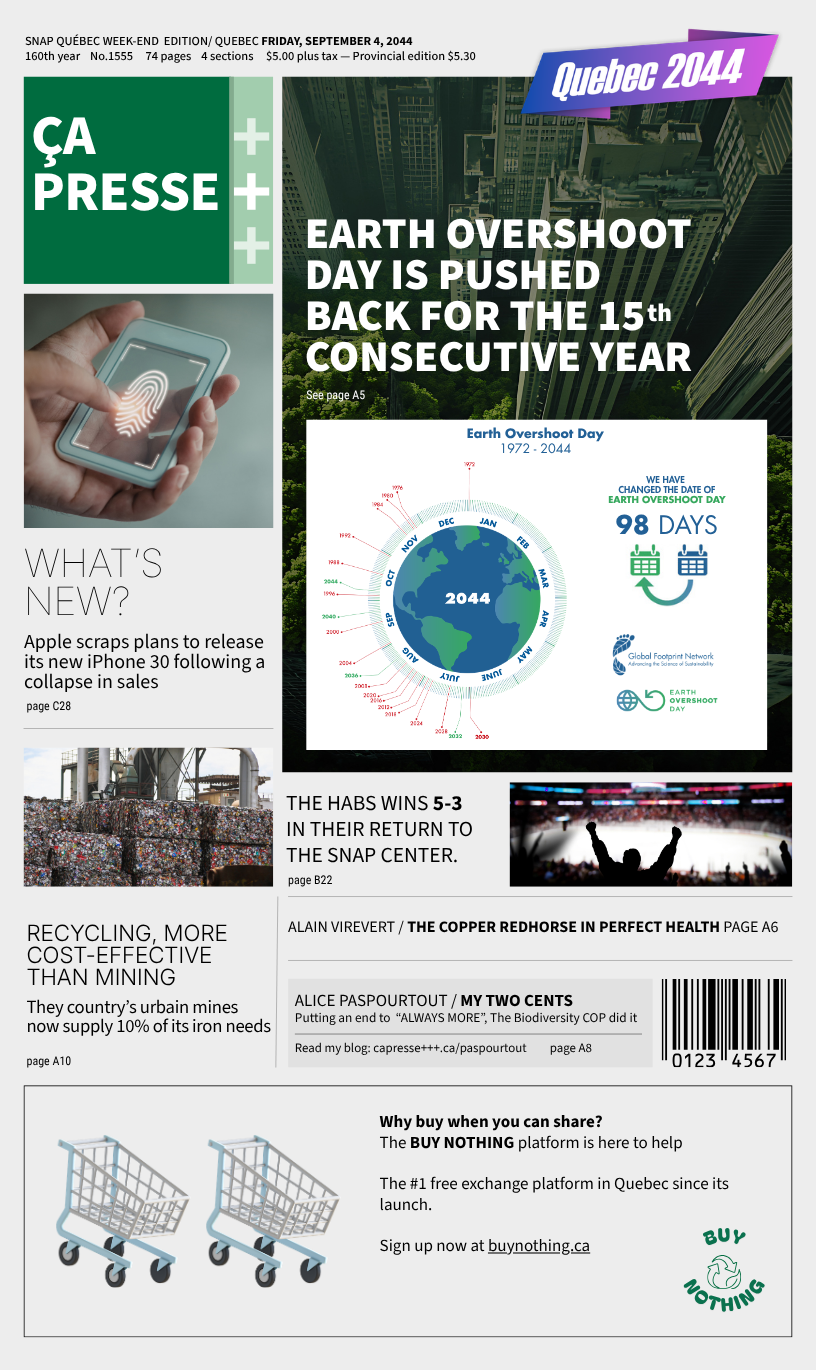
September 2044: Earth Overshoot Day Is Pushed Back for the 15th Consecutive Year
Thanks to ambitious policies implemented since the early 2030s to reduce humanity’s ecological footprint, Earth Overshoot Day continues to be pushed back in the calendar.
In Quebec, results are particularly encouraging. Since 2030, our consumption of ecological resources has been cut in half thanks to the protection of 42% of the province’s territory, the reduction of maritime traffic on the St. Lawrence River, and the proliferation of urban mines that allow raw materials to be recovered directly from municipal waste.
If all of humanity lived today like Quebecers do, we would need about 2.5 planets to sustain ourselves. That’s still too much, but it’s half as much as in 2030.
Science fiction, utopia, possibility, or necessity? In this entry from our “Quebec 2044” series, discover how to turn this good news from the future into reality.
What is Earth Overshoot Day?
Earth Overshoot Day marks the date on which humanity has consumed all the natural resources that the planet can regenerate in a year.
To calculate Earth Overshoot Day, the Global Footprint Network compares Earth’s capacity to produce resources and absorb waste (biocapacity) with our annual consumption of ecological resources (ecological footprint).
This is sometimes referred to as our “ecological budget,” and it should come as no surprise that we are living far beyond our means.
Since estimates began in the 1970s, Earth Overshoot Day has been occurring earlier each year. It has shifted from December 30 in 1971 to July 24 in 2025.
A staggering ecological footprint!
The ecological footprint, the key variable used to calculate Earth Overshoot Day, is an environmental indicator created in the 1990s by two Canadian researchers, Mathis Wackernagel and William Rees. Expressed in global hectares (GHa), it measures the pressure our lifestyles place on the planet.
The ecological footprint includes:
- the land we need to produce what we consume: agricultural land (food, textiles), grasslands and pastures (livestock and animal production), forests (forest products), fishing grounds, as well as built-up areas (roads, housing, infrastructure);
- the land and ecosystems we need to absorb our waste: notably the forests necessary for carbon storage.
To put this into perspective: Canada has an ecological footprint of about 8 GHa (global hectares) per person, which means that it takes about 8 hectares of land to support a single person’s lifestyle. However, the average biocapacity available on Earth is about 1.6 hectares per person. The discrepancy is huge!
How many Earths do we need?
For the past 50 years, we have been consuming the planet’s resources faster than they can regenerate: we emit more CO₂ than the biosphere can absorb, we use more freshwater than is replenished, we cut down more trees than can grow back, we fish faster than fish populations can recover, and so on. And the situation continues to worsen.
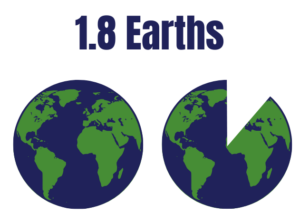
This overexploitation of resources is sometimes also expressed in terms of the number of planets required to sustain humanity’s consumption. In 2025, it was estimated that humanity needed 1.8 Earth’s to sustain itself.
Canadians are among the world’s biggest consumers
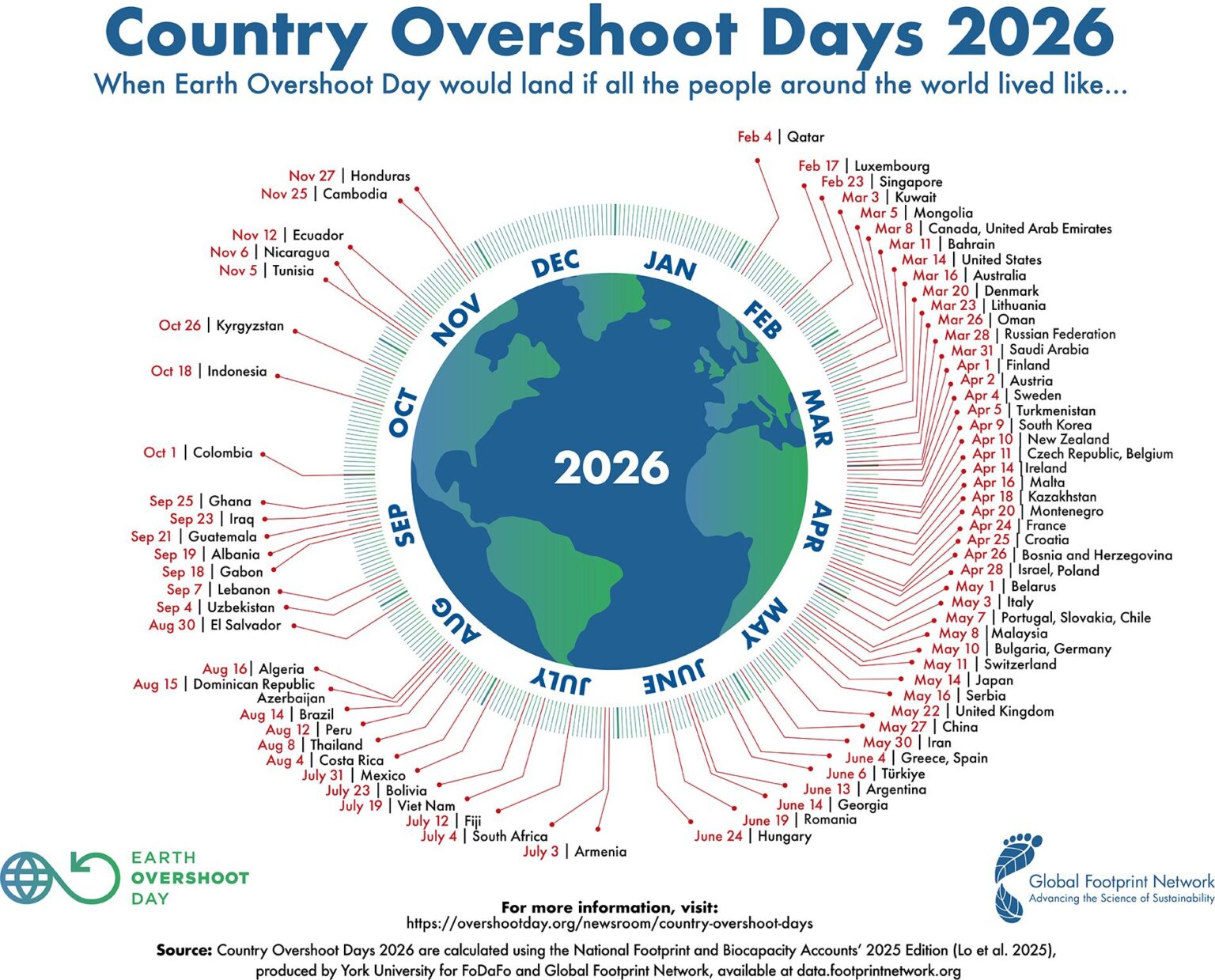
Earth Overshoot Day is also calculated on a country-by-country basis. We don’t have data for Quebec, but we know that in 2026, if the entire human population consumed at the same rate as Canadians, Earth Overshoot Day would have occurred on March 8. That’s four months earlier than the global date, and even four days earlier than in the United States!
Canada is one of the world’s worst resource consumers, and humanity would need five planets per year to sustain such a lifestyle!1
How can we reduce our ecological footprint?
Good news: there are many ways to reduce our ecological footprint and “move the date” of Earth Overshoot Day.
The creation of protected areas directly helps reduce our consumption of natural spaces and preserve our biocapacity. As we work collectively toward the goal of protecting 30% of our land by 2030, we should start thinking now about future protection targets for the coming decades. In fact, several scientific studies suggest that 50% of Earth’s land should be protected to preserve biodiversity more effectively. This value could even reach 70% protection for certain particularly sensitive ecosystems.2
But protecting more land will not be enough. To successfully reduce our consumption of resources and natural environments, we must also collectively transform our economic model. Scientists have been warning us for several years that the collapse of biodiversity is directly linked to global economic growth and that we need to fundamentally rethink our economic and financial paradigms—in particular, by moving away from the pursuit of short-term material gains.
In Quebec, for example, here are two concrete ways we could move beyond the paradigm of infinite growth and reduce our material footprint:
- Undertake a genuine transformation of the forestry regime
- Abandon the project to expand the Port of Montreal in Contrecœur
What you can do
Solutions are collective rather than individual, but it’s important for each of us to educate ourselves and become aware of the issues related to overconsumption of resources. Here are a few ways you can take it a step further:
- Calculate your personal Earth Overshoot Day: https://www.footprintcalculator.org/home/en
- Think of ways to reduce your consumption—for example, by following SÉPAQ’s advice on outdoor gear: https://www.sepaq.com/blogue/moins-equipement-neuf-plus-aventure.dot?language_id=1
Resources
Earth Overshoot Day website: https://www.footprintnetwork.org/our-work/earth-overshoot-day/
Ecological footprint by country: https://data.footprintnetwork.org/#/
IPBES report on transformative changes: https://www.ipbes.net/transformative-change-assessment